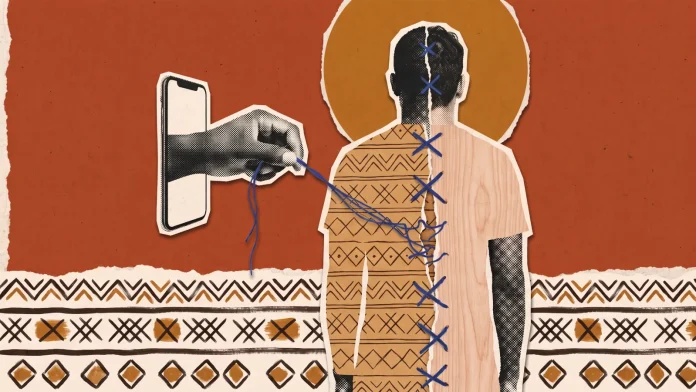
In a dim corner of a quiet café in Marcory, the Abidjan district known as “Little Beirut” for its many Lebanese residents, sits a citizen of Lebanese descent in his late thirties. These days his face is marked by deep worry. The more he scrolls through social media, the more anxious he becomes: online campaigns are swelling by the day and could end in physical attacks on his community — people singled out by their faces, the places they gather and the cafés where they sit. Sami, a pseudonym, asked Africa Voices not to reveal his identity, afraid of the online incitement campaigns aimed at anyone with a Lebanese name in Côte d’Ivoire.
Sami was born in Abidjan and spoke Nouchi, the street slang of Côte d’Ivoire, before he mastered the language of his grandparents. He has known no homeland but these Atlantic shores, and no passion but following the national team at the Africa Cup of Nations. All his life, in his forebears’ footsteps, he has worked in trade — a profession that, as Sami sees it, needs a great deal of warmth and closeness to the community around it to succeed.
His hands trembling slightly, he opens a video on his phone that lasts no more than 40 seconds. “This video is the reason,” he says quietly. “Forty seconds is enough to make all of us feel that our citizenship is a piece of paper that can be torn from us at any moment.”
Where the nightmare began: a calm video
The controversial video was recorded at around four o’clock on the afternoon of 6 November 2025. Hussein El Khayat, an Ivorian businessman of Lebanese descent, held up his phone and spoke calmly about Articles 70 and 71 of the Electoral Code. In the clip, posted on his TikTok account (hussk09), he said the two articles guarantee every naturalised citizen who meets the conditions the right to stand for municipal councils and for parliament — members of the Lebanese community included. He announced that he intended to stand in Agboville, the town his grandfather came from.
The video did not come out of nowhere. El Khayat was answering rumours that naturalised citizens had no right to stand, a year after an earlier wave of hatred against the community in November 2024.
Nothing El Khayat said went against the law. Article 72 of the Electoral Code bars from standing only those naturalised less than 10 years earlier — the rule the Independent Electoral Commission applied in its decision of 18 November 2025. The MP Tiémoko Antoine Assalé told the channel Life TV that a naturalised citizen has the same rights as any other Ivorian.
Even so, according to Fact-Check Congo, in an investigation produced with support from Code for Africa’s African Academy for Open Source Investigation, the video became the fuse for a spreading wave of online hate. By the time the investigation was published on 4 December 2025, the clip had passed 395,000 views, 10,800 likes and 1,800 saves on TikTok, and had been recirculated in more than 60 Facebook posts that drew over 7,400 comments — about 123 comments per post.
Forty seconds of calm talk about the law
Businessman Hussein El Khayat’s video on naturalised citizens’ right to stand for election, and what it had drawn by 4 Dec 2025.
Comments were switched off on the original TikTok video. But a Facebook post by the page CASH Ivoire, which recirculated it on 12 November 2025, filled up with inflammatory comments that Fact-Check Congo documented, among them: “Your citizenship is just a piece of paper that can be taken away from you” and “You will be nothing in this country, you’ll be running away very soon.”
To Sami, these “trends” felt like the start of a nightmare creeping into his life every day: threatening his business, seeping into the way his neighbours looked at him, until it reached his family’s safety.
Calm and coexistence, far from the algorithms
The community under attack is no passing presence in Côte d’Ivoire, nor a recent arrival. Its roots have run deep in the country since the early 20th century.
Popular memory has it that Abdellatif Fakhry, from the village of Zrariyeh in southern Lebanon, landed on the historic shores of Grand-Bassam in 1921. He was taking advantage of how easily people could move between the two countries under French rule — a mandate in Lebanon, colonial rule in Côte d’Ivoire — and hoped to expand his family’s trading business, which had begun in Dakar. People from his village and the villages around it soon followed. Over more than a century, the Lebanese community in Côte d’Ivoire grew into one of the largest Lebanese communities in Africa, moving from small shops in the alleys of Treichville to importing staple goods, and then to major investments in property and industry.
Ivorians have a joke for someone in a temper: “angry as a Lebanese man forced to take a holiday”. It captures two traits of the Lebanese there: a strong presence in society, and a love of work and productivity.
Estimates of the community’s size today range from 50,000 people registered with the consulate to about 100,000. Many of its families have made their mark on the country’s business map, such as the Omaïs family, pioneers in plastics manufacturing and the hotel trade. Not all the newcomers were Shia; there are Christian families too, among them that of the Lebanese physician Joseph Khoury — founder of the Polyclinique Avicenne in Abidjan, president of the Lebanese Chamber of Commerce and Industry in Côte d’Ivoire, and a member of the Economic, Social, Environmental and Cultural Council since 2014. One more thing helped the community succeed, despite its small size in a country of more than 30 million people: many families sent their children to finish their studies in Europe and America, and the children came back to Côte d’Ivoire.
Not “yesterday’s newcomers”
From south Lebanon to the Atlantic coast: how one of Africa’s largest Lebanese communities took shape, and what share of the country’s population it makes up today.
Another factor was their exclusion from government jobs in the African countries where they settled. Many therefore studied for professions that allow self-employment, such as architecture and medicine, while others carried on the trade their fathers had handed down. All of this made the community one of the country’s economic engines.
Out in Abidjan’s streets, the picture does not look as bleak as it does on the screens. In the crowded Adjamé market, Yassine, a 34-year-old Ivorian vegetable trader, believes the conflict that has flared up was not born in the street. “We’ve been buying our goods from Lebanese shops since I was a child, and we’ve shared meals and festivals with them,” he told Africa Voices. “The problem isn’t the shopkeepers or our neighbours. It’s the activists and politicians looking for scapegoats as the elections approach.”
“The problem isn’t the shopkeepers or our neighbours. It’s the activists and politicians looking for scapegoats”
Yassine, vegetable trader, Adjamé market
Hussein El Khayat — like Sami and many of their generation — was born in Abidjan, spoke Nouchi before Arabic, and shared the market alleys and a passion for football with his Ivorian peers. It is this coexistence, settled for a century, that the online campaigns set out to unsettle. That does not mean there are no grievances that the agitators exploit. Chief among them, as reported by Agence France-Presse and Fact-Check Congo, are anger at Lebanon’s kafala system — the sponsorship regime that ties migrant workers’ legal status to their employer — and at what African domestic workers endure there, and a feeling among some Ivorians that they face discrimination in everyday dealings.
The hate campaigns: how did the “Libouls” wave spread?
El Khayat’s video did not stay alone. Five days later, on 11 November 2025, the account “Ousby l’enfant béni” (“Ousby the blessed child”) posted a TikTok video accusing the Lebanese community of trying to take political control of the country, claiming that Lebanese people mistreat Black Mauritanians and Malians, and calling Ivorians to a “revolution” to stop it.
It was this post specifically that set off a wider wave using a derogatory word for the Lebanese: “Libouls”. The figures for the wave are spread across three monitoring bodies, each with its own platforms, time frame and methodology.
We begin with the two founding videos. Besides the figures for El Khayat’s video cited above, the Action Network for Justice and Peace (Réseau Action Justice et Paix, RAJP-CI) — in a report prepared under an incubation programme of the African Digital Democracy Observatory (ADDO) — counted more than 350,500 views, 30,200 likes and 5,200 shares on TikTok for the Ousby video. Two Facebook pages that reposted it drew more than 33,000 views and 4,000 interactions.
Then the circle widened. Using data from the Meta Content Library, the same network found about 400 Facebook posts using the word “Libouls” in November and December 2025 alone, while similar posts on X reached more than 819,000 people over the same period, according to data from Meltwater, the social media monitoring company the network relied on.
In a report published on disinfo.africa, Code for Africa’s iLAB team identified 256 individual Facebook posts between 9 November 2025 and 18 January 2026 — using a different methodology, limited to posts that addressed the Lebanese presence in derogatory terms. Those posts drew 7,032,094 views and 293,352 interactions: roughly 99,000 views a day for 71 days. In a second sample of 297 posts repeating the slogans “Non aux Libanais” (No to the Lebanese) and “Non aux Libouls” (No to the Libouls), collected up to 17 January 2026, the team recorded 1,853,033 views and 128,751 interactions.
256 derogatory Facebook posts in 71 days
Who counted what?
Three monitors from broadly the same ecosystem (Code for Africa and its partners), each with its own platform, time window and method, so their figures should be read side by side, not added up. Dashed line: approximate window, not specified by the source.
The campaign went beyond written posts. Between 14 and 29 November, Sessié Minkapeu, who presents himself as an evangelical preacher, posted videos on Facebook and TikTok accusing the Lebanese community of belonging to Hezbollah and financing terrorism, without any documented evidence. Then, on 30 November 2025, the artist and activist Tiesco Le Sultan released a song on his YouTube channel called “Non aux Libouls”. On its own it drew no more than 36,000 views and 3,635 interactions on the official channel, but it became the soundtrack to more than 2,700 TikTok challenge videos, and the hashtag “Non aux Libanais” (No to the Lebanese) alone passed three million views. Tiesco himself published 37 anti-Lebanese posts on Facebook between 13 November 2025 and 20 January 2026, which drew more than 11.4 million views, according to Code for Africa. The onslaught came amid unverified reports of money transfers to Hezbollah from Shia Lebanese emigrants — reports that have not been seriously substantiated.
These figures reveal three distinct dimensions. The first is emotional engagement, visible in the striking gap between the two videos’ like rates: likes came to about 8.6% of views for the Ousby video, against 2.7% for El Khayat’s — roughly 3.2 times higher. The gap suggests the inflammatory video drew more engagement than the calm, legal-minded one, with the caveat that the two videos’ figures come from different monitors.
The second shows in the average views per post. In the first sample — posts that addressed the Lebanese presence in derogatory language — it came to about 27,500 views, against 6,200 in the sample of short slogans: roughly 4.4 times as many. The derogatory narrative, with its stories and accusations, seems to have outdrawn the short slogan, even though the word “Libouls” appears in both samples.
The third dimension, the musical one, lies in how far the song spread into content made by users. A song that drew no more than 36,000 views on its official channel was attached to more than 2,700 challenge videos, and its hashtag passed three million views — more than 80 times the views of the song itself. Videos under the hashtag are not necessarily limited to the song; they may extend to other content.
What do the numbers say about how the campaign spread?
Of this tally, Sami says: “When you see thousands of accounts passing round the same sentences in the same minute, you realise you’re not just looking at spontaneous public anger.” His impression is partly borne out. Code for Africa identified a network of 15 accounts posting identical anti-Lebanese texts, and a Telegram channel that renamed itself “Non au Grand Remplacement” (No to the Great Replacement) on 15 November 2025 and launched a fundraising drive. But this evidence is not enough to establish who is behind the campaign, or how coordinated it was.
Across the timeline, the story began with a general warning that named no one; then the campaign’s milestones followed one another over four weeks in November, before the legislative elections were held on 27 December 2025.
A general warning, then seven months, then four weeks of escalation
04The 70% figure: an unsourced claim that repetition turns into “fact”
One figure came up in the misleading posts more than any other: that the Lebanese “control 70% of the country’s economy”. We found no official source for it. When Agence France-Presse put the figure to Serge Akl, director general of the Lebanese Chamber of Commerce and Industry in Côte d’Ivoire, in March 2026, he said there were no reliable statistics to back it. The chamber, he said, has between 150 and 200 member companies, almost all of them incorporated under Ivorian law, with little presence in the sectors that drive the economy — mining, oil, cocoa and agrifood — unlike large groups owned by Ivorians. Another figure, 40%, also circulates, attributed to The Economist in 2016 and to the newsletter Le Commerce du Levant; it too rests on no published official statistics.
One caveat: the number of companies registered with the chamber is not necessarily the sum of everything Lebanese people own in the country, because membership of the chamber is voluntary. A definitive answer would need independent data from the trade register and official statistics, which were not available to Africa Voices at the time of writing.
What the screen says, and what the available records say
05Rights bodies: a warning seven months before the campaign
This digital explosion did not come without warning from the country’s official human rights bodies, though the warning was general rather than aimed at the Lebanese community. On 28 March 2025, some seven months before El Khayat’s video, the National Human Rights Council (CNDH-CI), chaired by Namizata Sangaré, issued a statement from Abidjan. For several weeks, it noted, the political and social scene had seen “the exchange of insulting, hateful and discourteous remarks, widely relayed on social media”.
The council said it was concerned by “the rise of this verbal, and sometimes physical, violence, which is liable to weaken national cohesion and social peace and to threaten reconciliation efforts”, and condemned “the resurgence of hate speech and defamation” on platforms set up by militants of political parties and groups. It reminded those responsible that they could be prosecuted under Articles 226, 227, 228 and 231 of the Penal Code, as amended by Law No. 2021-893 of 21 December 2021. The first three of these articles criminalise discrimination, racism, xenophobia and tribalism, and raise the penalty to five years in prison when the offence is committed through the media.
But when the rhetoric did turn on the Lebanese community by name, we found no follow-up statement of the same kind. From El Khayat’s video to the time of writing, there is no trace of a council statement about this wave in particular, despite the scale of what RAJP-CI and Code for Africa documented. As a result, the official rights warning came before the campaign, not alongside it. The government took no direct public position until March 2026, when its spokesman, Amadou Coulibaly, called one of the anti-Lebanese rumours “utter nonsense” — after the campaign had flared up again with the outbreak of war in the Middle East.
Rumours were nothing new in the community’s daily life. In 2024 the Lebanese embassy in Abidjan denied fake “urgent warning” messages telling Lebanese people to stay indoors, calling them “totally unfounded”. That campaign coincided with preparations for local legislative elections, which passed off calmly.
The gap between the community’s fears and the calm at the polls is no contradiction. It is a picture of what the anti-Lebanese campaign did: the danger did not always lie in the ballot box, but in the psychological distance the screen planted inside an entire community — even as the street, as Yassine describes it, stayed calmer than the voices speaking in its name.
Sami ends our conversation, leaving his words hanging in the air: “My father lived here for 60 years and carried nothing but love for this land. I was born here, and I’ll never know anywhere else. But when your colleagues’ phones turn into platforms that question whether you belong, the Abidjan you love becomes a stranger to you. It’s as if you’re living in your own home, but as a tenant waiting to be evicted at any moment.”
This project is implemented with the support of the Arab Fund for Arts and Culture (AFAC), in partnership with Oxfam, Eco Electric and Megaphone, and co-funded by the European Union.