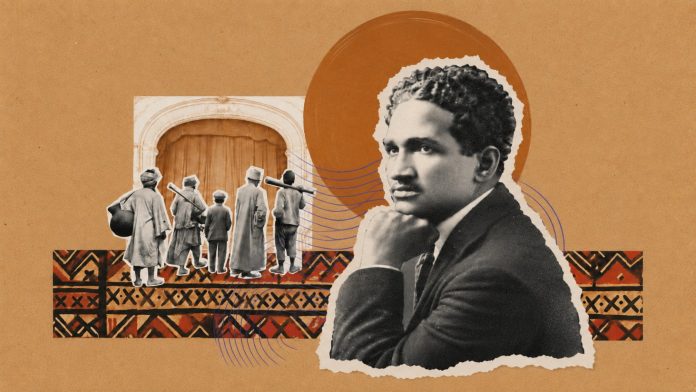
On 15 September 1923—not the 10th, as is still repeated each year—Sayed Darwish died in Alexandria at just 31, following only six years of theatrical work in Cairo. Yet his legacy was far greater than a body of memorable melodies. He transformed the place of ordinary people in music, turning them from a listening audience into the very substance from which songs were made. A century later, that transformation remains the central question of his enduring legacy.
Darwish did not emerge to rescue an impoverished Egyptian musical tradition. Long before him, Egypt possessed deeply established musical forms, maqams and traditions, as well as artists who had already secured important positions in its cultural life. Musical theatre, too, was becoming an increasingly important vehicle for music. Sheikh Salama Hijazi had helped move the song beyond the intimate takht ensemble and onto the stage, making it an integral part of the theatrical production itself. Figures such as Kamel Al-Khula’i and Daoud Hosni belonged to the same generation and were already laying the foundations for a profound transformation.
Darwish, therefore, entered neither a cultural vacuum nor a stagnant musical scene. He emerged within a mature tradition, a theatre that was beginning to recognise the importance of its audience, and a society undergoing rapid political and social change.
That is where his story truly begins.
At the beginning of the twentieth century, Cairo and Alexandria were not simply cities in which music was heard; they were societies being reshaped. Workers and artisans, civil servants and students, professionals in newly emerging occupations, a growing political movement and an expanding theatre-going public were all becoming increasingly visible in the country’s social landscape.
The streets themselves were acquiring new voices and new rhythms. With the Egyptian society undergoing rapid yet profound transformation, a question that would become both artistic and profoundly social came to the fore: Could music give expression to all these voices?
Sayed Darwish never answered that question in words. He answered it in music.
Where had his music come from
More than a century later, it is tempting to portray Sayed Darwish as a figure who emerged almost from nowhere and single-handedly transformed Egyptian music. The historical reality, however, is considerably more layered.
Born in Alexandria’s Kom El-Dekka neighbourhood in March 1892, Darwish grew up immersed in the musical culture around him. He heard muwashshahat, adwar and religious chanting; studied at a religious institute in Alexandria; sang at one of the city’s mosques; and absorbed the popular musical traditions of his surroundings. Some accounts also indicate that, before his musical career took off, he briefly worked as a construction labourer.
His path to professional music was shaped partly by chance. He joined the troupe of the brothers Amin and Salim Atallah and travelled with them to the Levant on two occasions: first, on a brief journey in late 1908, and later, in 1912, on a much longer stay that lasted roughly two years. It was during this second journey that his musical horizons broadened substantially. He learned to play the oud (lute), became acquainted with musical notation and pursued his studies in Aleppo.
Arabic sources have traditionally maintained that Darwish studied in Aleppo under the Iraqi chanter Othman Al-Mawsili. The nature and extent of that relationship, however, remain contested. Some Iraqi accounts have gone further, arguing that melodies later attributed to Darwish were in fact derived from Al-Mawsili. Egyptian sources reject this attribution, leaving the precise boundaries of Al-Mawsili’s influence open to debate.
These details matter for more than biographical reasons. They offer a window into how Darwish approached the musical heritage he inherited. He did not regard tradition as an obstacle to modernity, nor did he seek to construct something entirely new by abandoning what had come before. Instead, he absorbed existing forms, learned from them and reworked them for a changing social and artistic environment.
That may be one of the most important lessons of Darwish’s music: innovation does not necessarily begin with a clean slate. Sometimes, it begins by listening closely to what already exists—and discovering what it can become.
Darwish finds his stage
In 1917, Sayed Darwish moved to Cairo, marking a decisive turning point in his career. Sheikh Salama Hijazi had already helped establish the theatre as an important setting for musical performance, but Darwish found in it something more: a space in which he could experiment not simply with melody, but with what melody could do.
Over the following six years, he worked with the troupes of George Abyad, Naguib Al-Rihani, Ali Al-Kassar, Mounira El-Mahdeya and the Okasha brothers. In 1921, he went a step further and established his own troupe, opening with Scheherazade on 7 June. His theatrical output had already begun to expand rapidly: in 1918, he composed the music for Firuz Shah for George Abyad’s troupe and Walaw (Even if) for Al-Rihani’s. More works followed in quick succession, with sources putting the total number of theatrical productions for which he provided music at somewhere between 25 and 30.
The theatre changed the nature of composition itself. Once a melody becomes part of a dramatic work, musical beauty can no longer be the sole objective. The composer must also ask who is singing, why they are singing, what they are experiencing and what is happening on stage at that precise moment.
For Darwish, then, the theatre was not merely a platform on which melodies could be presented. It became his laboratory. Within it, he could make a group of workers sing collectively, allow a character’s inner state to unfold through song, turn a social encounter into a musical scene, or make the melody itself part of the dramatic action.
Grove Music Online, affiliated with Oxford University, describes Egyptian musical theatre of this period as moving towards greater simplicity and clarity of text, while at times incorporating forms of vocal synthesis. Specialist accounts of Darwish’s work, meanwhile, highlight his expanded use of choral singing, his practice of assigning distinctive musical treatments to different characters and groups, and his experiments with combining multiple vocal lines within a single scene.
Something fundamental was beginning to change. Music was no longer speaking about the people from a distance. Increasingly, it was beginning to speak in their voices.
The workers become a theme
Consider the song Al-Sanay’iyya (The Artisans), now widely known by its opening line, Al-Hilwa Di Qamat Ti’jin (“The lovely lady has risen to knead the dough”). On the surface, it is an unassuming song, close to the rhythms of everyday speech and grounded in an ordinary scene of work and domestic life. It appeared in the 1918 play Walaw (Even If), with lyrics by Badie Khayri, as part of a series of songs Darwish composed around different trades. Among them was Al-Saqqa’in (The Water Carriers), which also featured in the same production.
In his memoirs, Naguib Al-Rihani recounts the story behind the melody of Al-Saqqa’in. Darwish had spent three days struggling to find the right tune. Then, while walking in the street, he heard an actual water carrier calling out, “Ya’awwid Allah” (“May God compensate us”). The sound immediately provided what he had been searching for.
The anecdote captures something essential about Darwish’s musical imagination. He recognised the rhythm of labour itself as musical material. The worker on the street could therefore be brought onto the stage; the sounds of professions, the cadence of everyday speech, the physical rhythms of work and the collective movement of ordinary people could all become sources of melody.
This was more than a stylistic innovation. It marked a fundamental distinction between two ways of composing for the public. Some composers sing to the people. Others allow the lives of the people themselves to become music. Sayed Darwish belonged to the latter tradition.
That is why the celebrated title “Artist of the People”, while fitting, does not quite encompass the scale of his achievement. His deeper contribution was to transform the very source from which music could be created. With Darwish, the street was no longer merely the place where people lived, worked and sang. It became the raw material of composition itself.
Not just spectators
If we pause at this point, it becomes clear that Darwish’s project went well beyond the idea of the “popular song”. His aim was not simply to make melodies accessible enough for ordinary people to understand and enjoy. He sought to bring them into the musical world itself, making them participants rather than merely listeners. This helps explain the importance he attached to collective singing.
In his theatrical works, groups were often brought together to sing, turning the collective voice into an essential element of the dramatic scene. The practice did not begin in Cairo, however. It can be traced back to his early work with the Atallah Troupe, where he experimented with the Salamāt: collective vocal passages performed before the curtain rose and again at the end of the performance as a musical greeting to the audience.
There was a deeper idea at work here. Much of the established Arabic singing tradition had long centred on the solo voice, with the individual singer carrying the emotional and narrative weight of the song. That tradition remained immensely powerful after Darwish’s death, as demonstrated by the extraordinary reach of Umm Kulthum’s voice across Egypt, the Arab world and Africa.
Darwish began to expand the possibilities beyond the individual voice. A single singer could embody the experience of one person; a multitude of voices could embody the experience of an entire society. The audience, consequently, was no longer simply a collection of individuals sitting in darkness and listening to a performer on stage. The idea of the collective itself entered the musical structure, with people singing not merely as spectators but as a group.
In that sense, Darwish was redefining not only who could sing, but who music could represent.
The 1919 uprising
In 1919, Egypt took to the streets. The society that Sayed Darwish had previously encountered through the theatre was no longer simply material for artistic representation; it had become a historical force unfolding before him.
His name soon became inseparable from songs that would enter the Egyptian collective memory. Among the most prominent was Qum ya Masri (“Rise, O Egyptian”), from the 1919 play Qululhu (“Tell Him”), with lyrics by Badi‘ Khayri. Contemporary Egyptian press records indicate that the play, initially scheduled to premiere in March 1919, was postponed until May because of the revolution. The lyrics also contained coded references to Saad Zaghloul, whose name could not be mentioned openly under martial law.
Darwish is likewise closely associated with Biladi, Biladi (“My Country, My Country”), which he composed to lyrics by Mohamed Younis Al-Qadi, drawing on a speech by Mustafa Kamel. The song would eventually acquire an official status far beyond anything that could have been anticipated at the time: it became Egypt’s national anthem in 1979, 56 years after Darwish’s death.
But the significance of Darwish does not lie simply in the fact that he wrote patriotic songs. Patriotism had found musical expression before him. What distinguished his work was something deeper: the voice of the street itself was finding its way into music.
Al-Ummal (“The Workers”), known by its opening line, Ma qultlaksh in al-katra (“Didn’t I tell you that numbers…”), offers one of the clearest examples. The song appeared in the 1919 play Rann, with lyrics by Badi‘ Khayri and music by Darwish. It gave expression to workers’ grievances, capturing the hardships of everyday life and the weight of labour.
Arab sources have often read the song as an anthem of collective resilience in the face of oppression. Researcher Ziad Fahmy, however, places it within the more specific context of the austerity and rationing measures imposed by the British occupation authorities during the war years. The difference between these interpretations is revealing in itself. The song functions as a social document—not because it provides a literal record of events, but because it preserves something more elusive: how people experienced and felt about those events.
That may be the crucial distinction between a song that merely describes history and one that becomes part of how history is remembered. Darwish’s music did not simply accompany the events of his time. In many cases, it became part of their memory.
Modernist, but not following in the West’s footsteps
When discussing Sayed Darwish’s innovations, there is a tendency to reduce them to the introduction of new musical styles or to the influence of Western music. It is true that his work benefited from new musical knowledge and techniques, and that these helped broaden the possibilities of Egyptian musical theatre. But synthesis and collective orchestration were not his inventions alone; both were already present within the Egyptian musical-theatre movement in the decades before and during his career. Darwish’s distinctive contribution was to turn these techniques into dramatic necessities rather than leaving them as decorative additions.
For Darwish, modernity was therefore about more than technique. At its heart was a broader question: how could one create modern music for a society undergoing profound change? Every musical resource could serve that purpose. Traditional maqams, Arab rhythms and the takht ensemble could all remain in use, but their function and application could be transformed.
Music no longer had to exist simply to display its own aesthetic beauty. It could also become a means of expressing the experience of people living through a new era, giving musical form to their changing lives, aspirations and anxieties.
That, perhaps, is the most enduring form of modernity that Sayed Darwish left behind: not a fixed musical style, but a new understanding of what music could do in a changing society.
The man who didn’t live long enough
Sayed Darwish died in Alexandria only a few years after his name had become central to Egypt’s musical and theatrical life.
Even the date of his death calls for correction. Although 10 September 1923 is still widely cited, his tombstone records the date as 4 Safar 1342 AH, corresponding to 15 September 1923. Youm7, citing both the inscription on his grave and testimony from his family, has documented the discrepancy. He died at a particularly charged moment, when the country was awaiting the return of Saad Zaghloul from exile. As a result, his funeral procession moved through the streets in an atmosphere of near silence.
The circumstances of his death are themselves less certain. Accounts of its cause remain contradictory, and no definitive explanation has settled the matter. The familiar image of the “genius who died young” is therefore easy to invoke, but it can also obscure the more important point about what Darwish left behind. He did not establish a fully articulated school of musical thought. He opened a path.
His musical vision was far larger than the brief life available to him. Even the work he left unfinished, Cleopatra and Mark Antony, had to be completed by Mohammed Abdel Wahab and was staged four years after Darwish’s death.
The generations that followed would transform Egyptian music yet again. Recording technology, radio and cinema would reshape how music was produced, distributed and experienced, while new approaches to composition, arrangement and performance would emerge.
But Darwish had already accomplished something fundamental. He had demonstrated that music could be modern without abandoning its cultural roots; that it could draw upon inherited traditions without becoming imprisoned by them; that it could engage with politics without being reduced to propaganda; and that it could give expression to the worker, the artisan, the woman and the street without compromising artistic quality.
Above all, he helped establish the possibility that the listener need not remain outside the song. The listener—and the society to which that listener belonged—could become part of the story the music was telling.
So, what has changed
The thread remains unbroken. When mahraganat music today spreads from the streets of a working-class neighbourhood such as Matariya to audiences across Egypt, it raises essentially the same question that Sayed Darwish posed more than a century ago.
The most important question, then, is not how many songs Darwish composed, nor even which of his melodies became the most famous. It is what happened to Egyptian music once people began to recognise themselves in it. Perhaps that was the real revolution he left behind.
Darwish did not invent the people, any more than he invented music. What he did was bring the two together in song.
And from that moment, the people were no longer merely listening.
They began to sing.