Since last December, Egypt’s governorates—most notably Cairo—have witnessed a marked escalation in security operations targeting Sudanese and Syrian residents. According to non-governmental organisations, these campaigns, widely described as amounting to “systematic deportation”, have already led to the arrest of thousands.
..
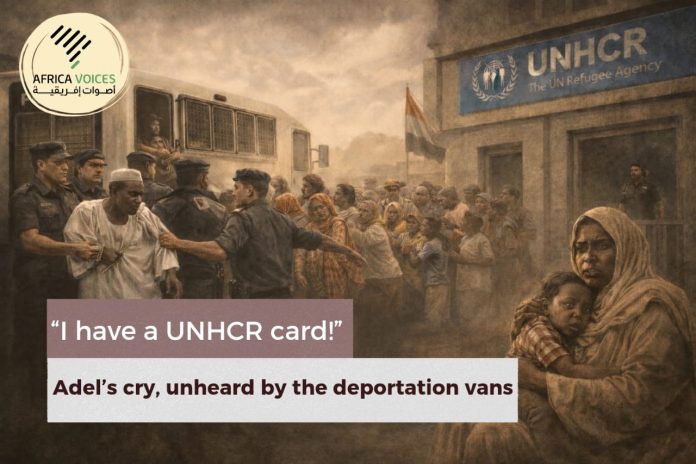
“I have my UNHCR card!” cried 25-year-old Adel as he was forcibly escorted towards a police van. He could never have imagined that a simple outing with friends in the Faisal district of Giza might prove to be his last day of freedom on Egyptian soil. Though his family had warned him and social media had been awash with reports of raids, Adel reassured himself that police vehicles would not venture into the narrow alleyways of the densely populated neighbourhood, preferring instead to patrol the main thoroughfares. That fragile comfort was shattered when a police vehicle drew up abruptly before him. Even after he produced his official UNHCR identification, the officers dismissed it, insisting that he speak Arabic.
Nargis, a Sudanese activist based in the Ard El-Lewa district and a friend of Adel’s family, conveyed to African Voices the gravity of the situation facing Sudanese residents in Egypt. “Everyone lives in fear,” she said. “Arrests are sometimes carried out solely on the basis of skin colour, on the presumption that anyone dark-skinned must be Sudanese.” With evident bitterness, she added, “Like Adel, many carried official identification cards, yet officers tore up these documents before their eyes and forced them onto buses”.
Since the outbreak of armed conflict in Sudan in mid-April 2023, Egypt has become the principal refuge for those fleeing the devastation. International estimates suggest that more than 1.2 million Sudanese have arrived in Egypt since the conflict began, joining an already substantial community of approximately three million. The Sudanese embassy in Cairo, however, places the total figure closer to six million.
Yet the security clampdown that commenced in mid-December has dramatically altered the atmosphere of the capital. The Sudanese presence—once clearly visible in the city’s streets in recent months—has begun to fade from view. Fear now keeps many indoors, wary of stepping into public squares or even venturing beyond their own neighbourhoods.
Panic is widespread across Sudanese social media networks, with community members sharing accounts of lives upended and families torn apart by arrests that are often difficult to verify. Some posts recount a woman taken into custody, leaving behind her elderly mother and autistic brother without any means of support. Others tell of a man in Alexandria who was detained while on his way to dialysis and died shortly after his arrest. Still others describe the death of an elderly man named Mubarak, who perished inside the Al-Shorouk police station in Cairo. Egyptian human rights organisations have also documented the death of 18-year-old Nazir Al-Sadiq at the Badr police station, following what his family characterised as inhumane treatment. Additional accounts describe relatives who vanished after leaving their homes, their fates unknown. Even the simple act of buying bread has become fraught with danger, as teenagers reportedly disappear after being sent by their mothers to make such purchases.
Nargis stated: “I no longer dare to send my child even to relieve himself, and patients avoid hospitals for fear of ambush. We live as hunted criminals, despite being nothing more than exiles”.
No protection
Faced with this surge of deportations, refugees describe themselves as “completely abandoned.” Fatima, another Sudanese activist, stated: “Neither refugee status nor legal residency permits offer us any protection now. We appeal to the UNHCR to prevent the deportation of minors, but our requests often go unanswered, and even the Sudanese embassy refrains from intervening”.
While the Egyptian authorities remain silent on the scope of these deportations, international data confirms the pace of the movement. At the end of January, the International Organization for Migration reported that over three million individuals had recently returned to their areas of origin in Sudan, 17 per cent of whom came from neighbouring countries, primarily Egypt. The Refugee Platform in Egypt estimates that deportation numbers have reached unprecedented levels, with approximately 5,000 Sudanese arrested during the last week of January and the first week of February. Simultaneously, Egypt has been operating return trains transporting Sudanese back to areas under the control of the Sudanese Armed Forces.
Nour Khalil, founder of the Refugee Platform in Egypt, attributes the problem to a “legal vacuum”. The majority of Sudanese refugees in Egypt lack valid documentation, as the UNHCR has established registration deadlines extending to 2027 and 2028, leaving many families without recognised legal status. Although recent Egyptian legislation allows for regularisation at a cost of $1,000, this sum is prohibitive for families who fled the horrors of war in such large numbers.
Like Nargis, Nour is unable to register her entire family. She arrived with seven children, requiring a substantial sum for regularisation, which must be renewed annually.
A report published by the Refugee Platform in Egypt, entitled “No Safe Haven: An Unprecedented Security Campaign Against Refugees in Egypt”, highlighted that “the residency renewal crisis and the chronic delays in registration and renewal procedures at the UNHCR and other official bodies have been used as a tool to effectively render large numbers of refugees ‘illegal’ on paper, despite the authorities’ awareness of the structural obstacles preventing them from regularising their legal status within the stipulated timeframes”.
The report confirmed that this pattern has been accompanied by repeated practices, most notably the confiscation of protection documents, including UNHCR cards, whenever refugees or asylum seekers were detained. This effectively deprived many of their recognised refugee or asylum-seeker status, permitting deportation orders to be issued outside any functioning framework of international protection or the guarantees of non-refoulement.
The pressure is not confined to Sudanese nationals; it also extends to Syrians, employing tactics widely described as “impossible”. Reports indicate that authorities are compelling detainees to book and pay for their return flights as a condition for release.
This on-the-ground security campaign has been mirrored by an intense cyber offensive. Over the past two months, the hashtag #Deporting_Migrants_Is_A_Popular_Demand has circulated widely, and according to the Sahih Masr platform, around 26,000 accounts have participated in disseminating hate speech, at times targeting Syrian-owned shops and restaurants. Khalil observes: “These campaigns are orchestrated by cyber brigades seeking to scapegoat migrants for the country’s economic crisis”.
Reasons unknown
While the motives behind this escalation remain opaque, media reports suggest rumours that the Sudanese Armed Forces may have requested Cairo to repatriate certain citizens to areas under its control, as well as to recruit young men to fight in the ongoing conflict.
Beyond these rumours, the Refugee Platform in Egypt links such measures to the deepening Egyptian-European partnership. The European funding programme for Egypt (€7.4 billion for 2024–2027) designates hundreds of millions of euros to combat irregular migration and to support “return and reintegration” initiatives.
Narges concludes: “Egypt has hosted us, and we hold it in the highest regard, yet how can we be forcibly returned to a homeland beset by famine, where there is no safe place to live?”.
The namers are changed for protection