It feels all too familiar, given how often it occurs and how similar the pattern is across the African continent, particularly in West Africa: a military general, driven by a deep-seated urge to depose the president, seizes power for years and takes control of the nation’s wealth, thereby inscribing his name in history as a ruler, regardless of whether this comes with development, efforts to fight corruption, or an attempt to establish stability.
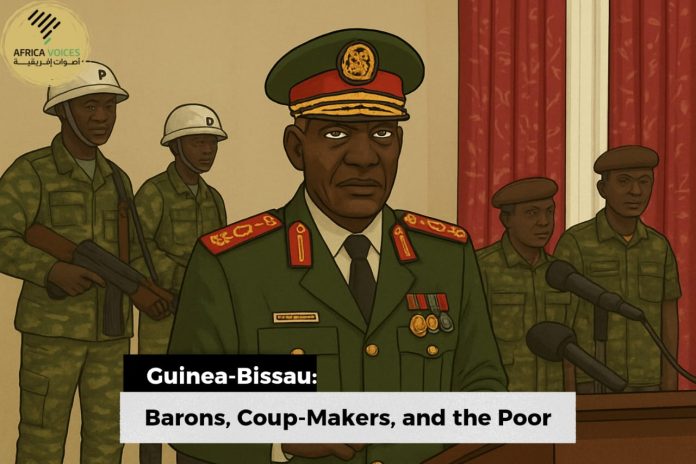
Horta N’Tam, the new transitional leader in Guinea-Bissau, is simply one of those military figures who persistently seek to rewrite history. As this small, densely populated, and economically fragile African country — weighed down by debt — prepared to announce its presidential election results, the army overthrew President Umaro Sissoco Embaló amid claims by the new leaders that the recent elections were rigged and linked to drug trafficking networks.
N’Tam served as army chief of staff before being appointed head of the Supreme Military Council, which will govern the country for one year, succeeding Embaló. Notably, he had been close to the ousted president and had previously intervened to prevent a coup against him in February 2022. Yet yesterday’s allies are not necessarily today’s.
This is hardly surprising, as this impoverished state remains ensnared in a turbulent history and an entrenched cycle of military interventions. From independence from Portugal in 1974 until the ousted president, Umaro Sissoco Embaló, assumed office in 2020, Guinea-Bissau witnessed at least nine coups and attempted coups.
This political fragility is reflected within state institutions and further exposes the clandestine networks active in drug trafficking, alongside the opaque connections between smugglers, politicians, and officials. Guinea-Bissau has been labelled Africa’s foremost narcotics state by the United Nations, and its territory has long served as a major transit point for cocaine smuggling from South America to Europe
According to figures from the United Nations Office on Drugs and Crime (UNODC), the value of the drug trade in Guinea-Bissau surpasses the country’s national income. Guinea-Bissau also records one of the highest rates of drug use globally, ranking 177th out of 191 countries in the 2021 UN Human Development Report.
This trade involves traffickers, smugglers, military officers, and senior government officials who have been accused of using their influence to act as intermediaries and facilitate the movement of individuals from Latin America. In March 2024, the son of former President Malam Bacai Sanha Jr. was sentenced to several years in prison in the United States for participating in an international heroin smuggling scheme. Meanwhile, the ousted president refused to extradite General Antonio Ndjai — who had led a previous coup — to the United States on charges of drug trafficking in collaboration with FARC guerrillas.
Politics is far from immune to this illicit economy, with suspicions that some political campaigns were financed by drug traffickers. Parties rapidly acquired luxury SUVs to traverse the country, and their sudden wealth was plain to see; they purchased cars and enormous villas without any visible sources of income. The United States even designated some of their officials as drug barons.
It is striking how many coup leaders in Africa, particularly in West Africa, appear to share a single characteristic: an eagerness to cling to power for as long as possible. Some of these coups have gained de facto recognition, while others remain unrecognised.
Some coups manage to draw popular support by overcoming obstacles to political succession, as seen in Gabon and Guinea, where citizens have lost trust in the political system and the military has exploited public concerns about accountability and entrenched rule to justify its actions. Yet a 2023 UNDP report noted the prevalence of “buyer’s remorse” among those who initially backed the coups in Burkina Faso, Chad, Guinea, Mali, and Sudan, as people became increasingly disenchanted with the new rulers.
Elsewhere, especially in Mali, Niger, and Burkina Faso, anti-colonial and anti-French sentiment has been weaponised among young people to maintain popular backing. Russia has also attempted to take advantage of anti-Western sentiment and appears to be offering praetorian protection to shield these regimes from counter-coups. While motivations vary — including a shared opposition to French presence — it is as though all these regimes are following the same playbook. Indeed, it is not difficult to anticipate further instability and additional coups across Africa.
Translated by: Mostafa Hassan