At five in the morning, while the streets of the Senegalese capital are still cloaked in pre-dawn darkness, Abdoulaye steps outside. No mobile-phone alarm wakes him, nor does a mother’s embrace await him with a warm breakfast. He rises for one reason alone: to fill his small plastic container before nightfall.
Barefoot, he walks across Dakar’s cold asphalt, holding out his hand to strangers and collecting whatever money he can to take back to his sheikh. This has been his life since he was taken from Mali to Senegal along a desert route at the age of four. Yet Abdoulaye’s ordeal extends beyond poverty and exploitation. In legal terms, he does not exist. He has neither a birth certificate nor an identity card. To the state, Abdoulaye is a phantom. He is a child moving through life without papers, protection or official recognition.
When a kuttab turns into a trap
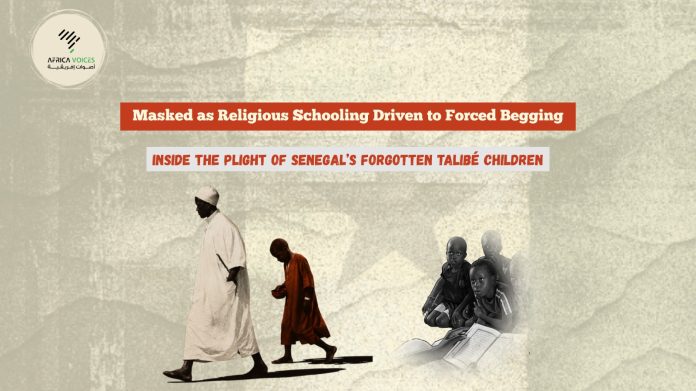
In Senegal and across parts of West Africa, traditional Qur’anic schools are known as daaras, and their pupils as talibés or talaba. They broadly resemble the kuttab once common in rural Egypt, where families entrusted their children to a murabit or Sufi sheikh to memorise the Qur’an and learn the foundations of the faith, in the hope that they would one day return as a source of knowledge and blessing for their communities.
It was with that expectation — and under the pressure of poverty — that Abdoulaye’s family sent him from a remote village in Mali to Senegal. They imagined a place of religious learning. Instead, the reality of many daaras in the backstreets of Dakar and Touba was starkly different. There, survival and revenue often take precedence over education, and the child is reduced to one small part in a larger system built around street begging.
One supervisor at a shelter on the outskirts of Dakar, who asked not to be named, sought to explain the logic from within. Speaking to Africa Voices, he said: “We do not send them into the streets without reason. We are teaching them self-denial and humility. A child going out with his container is part of an upbringing that makes him feel the suffering of the poor before he becomes a scholar”.
Yet that justification collides with the scale of the problem documented by researchers and rights groups. A report published in April 2026 by the Berkeley Center for Religion, Peace, and World Affairs at Georgetown University found that more than 100,000 children in Senegal alone live under this system, spending their days exposed to the brutality of street life rather than the religious education that was meant to define their stay there.
The picture grows darker still in the findings of Amnesty International, which has reported that roughly a quarter of these children are victims of what it describes as forced begging — a practice in which a child is turned into a daily source of income for his sheikh, often under threat or coercion.
The cost of survival, at the lash’s mercy
Within many of these daara networks, begging is not incidental but institutionalised — a daily obligation enforced with the rigidity of a tax. Each child is expected to hand over a fixed quota to his sheikh before the day ends, typically around 400 to 450 CFA francs, along with basic provisions such as rice and sugar. The amount may appear modest, but earning it on Dakar’s crowded streets can mean hours of standing in the heat, weaving through traffic and chasing cars for spare coins.
When a child falls short, the punishment can be brutal. Human Rights Watch, in its report Off the Backs of the Children, documented a pattern of abuse that included severe beatings with sticks and electric cables, and in some cases the chaining of children to stop them from running away. The violence was not presented as an aberration, but as part of a system sustained through fear and coercion.
Corinne Dufka, a former Human Rights Watch researcher, captured the essence of that reality in remarks to Africa Voices: “When a young child’s pot becomes a source of income for others, and the fear of punishment becomes part of his daily life, we are not looking at religious instruction. We are looking at a modern form of slavery”.
Abdoulaye lived under that threat every day. He would return to the daara clutching the few coins he had managed to collect, dreading the reckoning that awaited if the total fell short. At times, the fear of his sheikh’s anger was so acute that he chose to sleep rough on Dakar’s pavements rather than go back and face the consequences of failure.
Those meagre coins, gathered under duress, feed a shadow economy that has drawn sustained international scrutiny. In its report These Children Don’t Belong in the Streets, Human Rights Watch documented how money extracted from talibé children was, in some cases, diverted to finance the personal lifestyles of certain sheikhs rather than the care, education or rehabilitation of the children themselves.
It is this organised extraction of money — driven by recruitment, coercion and daily collection quotas — that has pushed the issue beyond the realm of social neglect and into that of organised criminal exploitation. International and Senegalese rights groups, along with anti-trafficking bodies, have increasingly framed the practice as one that bears the hallmarks of human trafficking and slavery-like exploitation, giving Abdoulaye’s story a significance that extends far beyond the suffering of one child.
The sheikh orders and the state remains silent: The laws’ dispute with loyalties
The obvious question is where the Senegalese state stands amid these daily scenes — and why the law has so often failed to shield thousands of children from exploitation. Part of the answer lies in the dense relationship between state authority and the country’s powerful Sufi brotherhoods, above all the Mouride and Tijaniyya orders.
These brotherhoods wield influence far beyond the religious sphere. During election campaigns, politicians have long courted what in Senegal is known as the ndigël — an instruction from a senior religious leader directing followers towards a particular candidate. In a country where spiritual allegiance can translate into a decisive voting bloc, that authority has helped create a form of political untouchability around influential marabouts, making any direct challenge to the system of the daaras a high-risk move for elected leaders.
That political caution has repeatedly blunted the force of the law. Senegal does have legislation on the books, including a 2005 anti-trafficking law, yet enforcement has remained patchy and inconsistent. Abdoulaye recalls the fanfare that accompanied former president Macky Sall’s 2016 pledge to ban child begging. On the streets, however, little changed. The next morning, he says, he went out with the same plastic bowl, passing police officers who simply watched. To him, it felt as though the authority of the religious lodge outweighed that of the state itself.
That contradiction is at the heart of what Senegalese rights advocates describe as a culture of impunity. Speaking to Africa Voices, the activist Mamadou Diallo argued that the real obstacle was not the absence of laws, but the social and political sanctity surrounding the marabout. In his telling, the police may have legal powers on paper, but the deference shown to religious authority often prevents those powers from being exercised inside the daara system. Promises of reform, he suggested, repeatedly collide with a deeply rooted belief that confronting the sheikh means challenging religious blessing itself.
The arrival of a new administration in 2024 under President Bassirou Diomaye Faye has not, at least so far, resolved that dilemma. The rhetoric of change now runs up against what researchers have described as broad social tolerance for exploitative practices when they are cloaked in the language of religious education. Laws may be drafted to meet international standards, but the combination of clerical influence, political caution and public silence continues to limit accountability — leaving children such as Abdoulaye trapped between the authority of the state and the power of the lodge.
At fifteen: Fleeing to the unknown
By the age of fifteen, Abdoulaye had reached the limit of what he could endure. He made the hardest decision of his life: to leave the daara and strike out on his own. In doing so, he put down the plastic bowl for good. No longer would he beg on behalf of a sheikh; instead, he would survive by his own labour, swapping the proceeds of street collection for whatever bread he could buy through the work of his own hands as a porter in the markets.
Looking back on that turning point, Abdoulaye told Africa Voices that his decision was born not of hostility to religion, but of sheer physical exhaustion and fear. “I ran away because my back could no longer bear the pain of the electric wires,” he said. “It was not because I hated religion. On the street, I was sometimes forced to steal in order to survive, but at least I became the one who decided my own fate”.
Yet escape from the daara did not bring him into safety. Instead, it exposed him to a different form of abandonment — one shaped not by the authority of a sheikh, but by the indifference of the legal system. Smuggled from Mali into Senegal without a birth certificate or travel documents, Abdoulaye had slipped into a blind spot in international law. He was not recognised as a refugee fleeing war, nor as a migrant with papers linking him to a state that could receive him, nor even as a citizen acknowledged by Senegalese records. In effect, he existed outside the categories on which protection depends: a boy without documents, nationality or legal visibility, living beyond the reach of official recognition.
A phantom at 24
When Abdoulaye turned 20, a rare opportunity appeared to offer him a way out. A Chinese construction company offered him work abroad — the kind of chance that might have lifted him out of grinding poverty and given him a route to financial independence. But the prospect collapsed at the first bureaucratic checkpoint. To travel, he needed a passport; to obtain a passport, he needed a birth certificate. Abdoulaye had neither. Beyond the name given to him by his mother in Mali, he possessed no official document capable of proving that he existed. The offer disappeared against the hard wall of missing paperwork.
Today, in 2026, Abdoulaye is 24. In Dakar’s crowded Sandaga market, where vendors’ cries mingle with the roar of buses and the constant churn of trade, he can still be found hauling heavy loads on his back for a few coins, earning a living through sheer physical endurance.
He ends his story with a line that captures the full weight of his exclusion: “The hardest thing is not the hunger. It is that when I see a plane in the sky, I know I will never board it — not because I am poor, but because I do not have a single document to tell the world who I am”.