At eleven o’clock at night, the Hadayek el-Ahram district in Giza Governorate lay in darkness. The shops had closed their shutters, and the streetlights had been switched off in accordance with the Egyptian government’s energy rationing plan introduced weeks earlier. The stillness was suddenly broken by the raised voices of an elderly, dignified man shouting at a group of Sudanese teenagers who were passing the time outdoors late into the night.
I did not know what had triggered the altercation, which lasted only a few minutes, but the man appeared furious, hurling abuse at refugees and migrants in Egypt. He held them responsible for the country’s energy crisis, which he linked to the American-Israeli war on Iran, as though they had set the conflict in motion or shut the Strait of Hormuz, through which a quarter of the world’s oil exports pass. He went on with his relentless tirade, insisting they leave the country, convinced they were the source of many of the economic hardships accompanying their forced displacement to Egypt.
The man eventually walked away, but I was left reflecting on how he had been shaped by the increasingly racist rhetoric directed at refugees and migrants, which has intensified in recent months across Egyptian social media platforms. Pages and accounts have been observed calling for the deportation of Sudanese and Syrians in particular, rejecting what they describe as attempts to resettle them in Egypt.
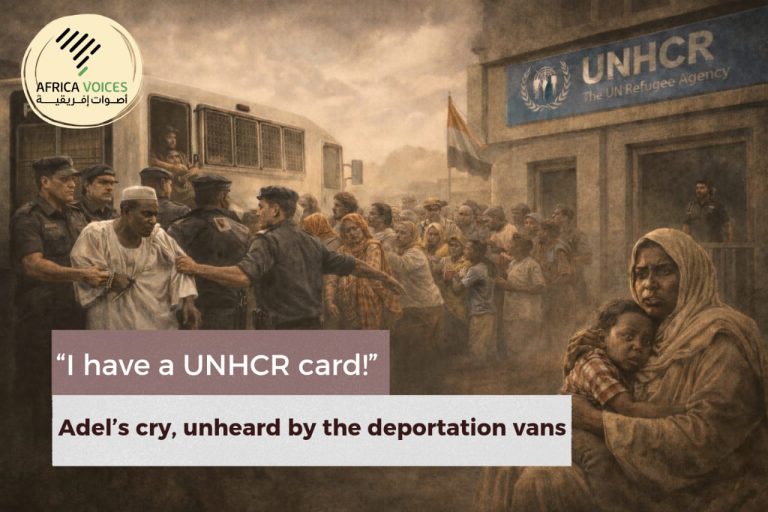
This online campaign has coincided with security operations targeting thousands of migrants and refugees, including those without valid residency permits, as well as others found carrying the yellow card issued by the UNHCR in Egypt to asylum seekers.
This campaign has taken a tragic turn, with human rights organisations reporting the deaths of six refugees, most of them from the Sudanese community, in detention centres. They had been arrested in various locations as part of a broad security campaign targeting refugees, asylum seekers, and migrants in Egypt over recent months—a campaign that, according to reports from the “Refugees in Egypt” platform, has intensified markedly since the beginning of this year.
The latest reported victim of this campaign is Rashid Mohamed Abbas, who was registered with the UNHCR in Egypt. He was arrested in the first week of March 2026 while leaving his home to purchase basic necessities for his family. It remains unclear whether his death occurred inside the detention centre itself or during transfer to the airport for deportation under the guise of “voluntary return”.
Alongside these field operations, Egypt’s digital space has witnessed a coordinated surge of hate speech and incitement against refugees, asylum seekers, and migrants. The “Refugees in Egypt” platform has documented increased activity across numerous social media accounts, many of them anonymous or operating under misleading identities. According to the platform, these accounts have systematically circulated false or unverified claims about refugees, associating their presence with crime and economic decline, and generalising isolated incidents in order to inflame public sentiment against them on the basis of nationality or race.
These online campaigns have coincided with the discourse adopted by pro-government media figures regarding the refugee issue. For instance, Ahmed Moussa criticised the announcement of a partnership between the Hayah Karima Foundation—a presidential initiative aimed at improving living conditions in rural Egypt—and the UNHCR, which sought to explore the integration of refugees into the foundation’s development programmes, particularly those focused on economic empowerment.
Moussa argued that directing support towards refugees raises difficulties in light of Egypt’s economic conditions, framing his position within the broader pressures facing the state. In his criticism of prolonging the period of hosting refugees despite what he described as stabilising conditions in their countries of origin, he further claimed that refugees share in the Egyptian people’s share of water amid reduced availability due to the Renaissance Dam, and consume wheat that Egypt imports, as well as oil that Cairo brings in from abroad.
The host of the show “(Ala Mas’ouliyaty – On My Responsibility)” went on to say: “The priority should be helping our people. The Haya Karima (Decent Life) initiative is designed for Egypt, for the Egyptian people, not for foreigners. It is called ‘Decent Life’. When this project was launched, it was launched for rural Egypt, for the people”.
This is not the first time Ahmed Moussa has criticised Egypt’s hosting of large numbers of refugees. He has previously called for their deportation, describing their presence as “extremely dangerous” and an economic burden, given the difficult conditions facing the Egyptian economy. He is not alone among Egyptian television presenters; Youssef El-Husseini has also expressed surprise at the partnership between the Haya Karima initiative and the UNHCR.
Amr Adib has likewise called for a review of the issue, clarifying that he is not demanding the deportation of refugees, but stressing the need for Egypt to receive the necessary support to shoulder what he described as this burden. He also questioned the role of European countries, which, in his view, prefer that refugees remain in Egypt.
Conflicting figures
From time to time, the Egyptian government reiterates its claim that it is hosting nine million refugees and residents within its borders. The Egyptian Foreign Minister, Badr Abdelatty, has recently added another million to this figure, criticising what he described as the lack of international support, which he considers disproportionate to the growing burden, and pointing to shortcomings in the international commitment to the principle of burden-sharing.
However, a recent report by the United Nations High Commissioner for Refugees (UNHCR) indicated that the number of refugees and asylum seekers registered with the UNHCR and residing in Egypt as of 31 December 2025 stood at 1,098,311, representing around 60 nationalities. Sudanese nationals formed the largest group, numbering approximately 834,000, while Syrian nationals registered in Egypt totalled 117,000. The remaining nationalities accounted for about 146,000 refugees and asylum seekers.
This discrepancy in estimates between the Egyptian government and the UNHCR has generated confusion and contributed to the rise of hate speech directed at refugees. Official discourse often oscillates between presenting the country as generously hosting large numbers of refugees—frequently referred to as “guests”—and emphasising the additional economic burden, which the government estimates at around $10 billion annually for education and healthcare services provided to refugees and asylum seekers.
The cost of hosting refugees has become a point of growing frustration among both official and non-official Egyptian voices. President Abdel Fattah al-Sisi has previously stated at a conference that “the guests consume up to 4.5 billion cubic metres of water annually”, based on an average per capita consumption of approximately 500 cubic metres per day in Egypt.
This official discourse is primarily directed towards the European Union and countries concerned with combating irregular migration. Whenever the government raises the issue of the refugee burden, alarm bells are triggered on the European side, which fears potential flows of migrants towards its shores. In March 2024, the European Union and Egypt agreed on a €7.4 billion aid package, most of which takes the form of loans aimed at boosting trade and investment in Egypt. It also includes €200 million allocated to border management and the enforcement of migration laws.
The European Union has also previously allocated an additional €20 million to support displaced people fleeing the war in Sudan, in response to the conflict’s impact on irregular migration flows across the region and the Mediterranean.
However, this form of cooperation has drawn criticism from human rights organisations working on refugee issues. They argue that European grants have not led to meaningful changes in security practices, pointing instead to a recent rise in the arrest and detention of refugees. They also highlight what they describe as a systematic increase in hate speech campaigns on social media targeting refugees, asylum seekers, migrants, and those who defend or advocate for them.
The attribution of non-endemic diseases in Egypt, such as meningitis, to refugees and migrants is not an isolated case. Although the Ministry of Health denied reports of its spread in Egypt following cases detected among students in the Democratic Republic of the Congo and England, some commentators nevertheless linked the outbreak to the recent rise in the number of refugees granted asylum in the country.
There is a parallel between the woman who opposed the opening of borders to African communities, fearing they might carry the virus, and the man who shouted at a group of Sudanese teenagers. Both are equipped with mobile phones and follow news reports suggesting that Egypt incurs an annual bill of $10 billion for services provided to refugees, while life grows increasingly difficult for them as rising prices consume their limited incomes and push them closer to the poverty line.
The deeper dilemma facing the Egyptian government today lies in its attempt to reconcile the economic benefits associated with hosting refugees with the need to control its borders and prevent irregular migration towards European countries. This is further complicated by both explicit and implicit public dissatisfaction with continuing to assume this role due to the additional burdens it entails. It also renders more salient the gap between the rhetoric of “welcome guests”, as used in official discourse, and the reality of refugees whose stay is seen as having run its course, and whose time, as journalist Ahmed Moussa has put it, has come to return to their homelands.