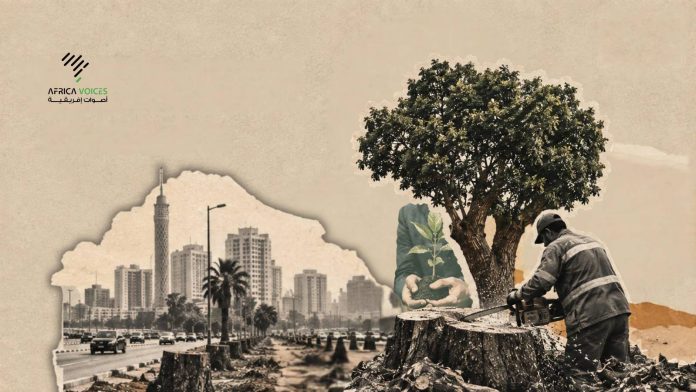
On his regular journeys between construction sites in Cairo and his hometown in Upper Egypt, Ahmed Mahmoud, 28, was accustomed to escaping the capital’s concrete sprawl in search of a patch of greenery. Working in construction, he had witnessed first-hand how urban expansion devours open spaces. Yet he never imagined that the same development mindset would reach his village.
When he stepped off the bus in a village in Qena Governorate, a wave of scorching air hit him, like the heat pouring from an open oven. Instinctively, he turned towards the shaded spot where he had sought refuge for years beneath a dense row of trees along the Luxor Agricultural (Tourist) Road. Instead, he found severed trunks and asphalt shimmering beneath the midday sun. The trees had been felled.
The clearance included at least 100 mature trees in a single administrative district. The decision was reportedly justified by concerns raised by tourism companies that trees or their branches might fall on tourist buses travelling along the main road.
Wiping the sweat from his brow, Ahmed told Africa Voices: “Buildings are going up every day, while new cities are expanding their green spaces and planting more trees. Yet outside those cities, the very trees that protect us are being cut down under one pretext after another. When the felling reaches our last line of environmental defense here in Upper Egypt, we lose the shade that shelters us and face a serious threat to our environment, our health and even our lives”.
Ahmed’s experience highlights a broader contradiction in Egypt’s approach to urban development and environmental protection. While government officials extol afforestation and urban greening initiatives, local authorities continue to fell trees on the ground. Critics point to legislative loopholes that, they argue, allow such practices to proceed with limited accountability. For residents exposed to Upper Egypt’s punishing summer heat, the consequences are immediate: less shade, greater exposure to extreme temperatures and the loss of trees that help make their surroundings more liveable.
The Lost “Lungs” of the City
Under summer’s scorching sun, from southern Egypt to the streets of the capital, finding a patch of shade has become a daily struggle.
In Cairo’s affluent Mohandessin district, residents were shocked to discover that trees had been stripped from League of Arab States Street and the area around Mostafa Mahmoud Square as part of traffic reconfiguration and metro expansion projects.
The historic thoroughfare was transformed into a vast, sun-baked stretch of asphalt, sparking public outrage and prompting judicial intervention. The Public Prosecution subsequently ordered a wide-ranging investigation into the legality of the tree removals.
“Trees are the lungs that protect the neighbourhood and preserve its history,” said Shoukry Asmar, a Heliopolis resident, recalling the past with evident sadness.
Asmar remembers 2011, when he and his neighbours established the Heliopolis Heritage Initiative to protect the district’s architectural and environmental character. By 2017, the initiative was confronting plans for new expressways that resulted in part of the historic Granada Park being carved away. In 2019, the site was converted into a car park, before the remaining section was demolished in 2022.
Over just five months between 2018 and 2019, the initiative recorded the loss of approximately 396,000 square metres of vegetation.
Further south, in Maadi, local authorities pruned and felled historic trees, particularly along Damascus Street and Street 154, as well as in parts of Zahraa El Maadi. The familiar justification was the need to “respond to residents’ complaints about the danger posed by falling old trees”.
Between 2017 and 2020, Cairo lost approximately 910,894 square metres of green space, according to the figures cited, sending the amount of green space available per resident plunging from three square metres to just 0.74 square metre. Studies by Alternative Policy Solutions and the Organisation for Economic Co-operation and Development (OECD) have documented the decline. The resulting provision falls far short of the World Health Organization’s recommended minimum of nine square metres per person to support mental and respiratory health, as well as Egypt’s Vision 2030 target of three square metres per person.
A study published by Springer Nature found that green space per capita in 22 of Cairo’s 37 districts, home to two-thirds of the capital’s population, had fallen to less than half a square metre. The figure is also well below the seven-square-metre minimum stipulated in Egypt’s Urban Harmony Manual. Research by Alternative Policy Solutions, a project at the American University in Cairo, likewise documented the loss of approximately 311,000 square metres of green space in Nasr City and 272,000 square metres in Heliopolis.
Alexandria, Egypt’s Mediterranean coastal city, has suffered a similar decline. Between 2013 and 2023, it lost around 36 per cent of its total green space, equivalent to 2.92 million square metres, amid development schemes and road-widening projects.
Extensive tree-felling and pruning operations have also affected ancient and rare specimens in the historic Montaza Gardens, particularly rare casuarina trees in the Aida area, as the heritage site underwent redevelopment and rehabilitation. The removals extended to major thoroughfares, including Abu Qir Street in the Sporting and Cleopatra districts of eastern Alexandria, as well as areas along the Mahmoudiya Canal project corridors. Local authorities have cited a familiar rationale: “comprehensive development, urban redesign and the widening of coastal traffic arteries”.
Green Talk, Blazing Saws
The continued felling of trees has been accompanied by a steady stream of official rhetoric promising a greener Egypt.
As saws brought down trees in Mohandessin, the Prime Minister was chairing an expanded meeting to review progress on the Greening Cairo project, instructing officials to “halt tree cutting and transform the spaces beneath overpasses into gardens”.
The initiative appeared to complement Egypt’s diplomatic efforts on environmental protection, particularly as the country prepared to host the 18th Conference of the Parties to Combat Desertification (COP18) in 2028, with a focus on protecting land across Africa.
In September 2026, a statement attributed to the Minister of Local Development and Environment concerning state contracts for coal exports triggered an even stronger public backlash. The Cabinet responded with a forceful denial, reaffirming its commitment to protecting green spaces and stressing that no trees could be removed without the approval of the governor and the Environmental Affairs Agency.
Yet the reality on the ground, as Ahmed’s experience in Upper Egypt illustrates, points to administrative practices that can effectively circumvent these directives.
When residents asked the local council why more than 100 trees had disappeared, they were told that the trees posed a “hazard to tourist buses heading to Luxor” and Aswan. A similar pattern emerged in the city of Qena, where historic trees were uprooted under the pretext of landscaping central road medians.
A study published by Global Nature Watch attributed approximately 4,472 feddans of tree-cover loss, or 95 per cent of the total, to human activity rather than natural disasters.
The legal framework presents a further contradiction. Egypt’s Penal Code (Law No. 58 of 1937), Environment Law (Law No. 4 of 1994) and Irrigation Law (Law No. 147 of 2021) all criminalise the unauthorised felling of trees. Critics, however, contend that enforcement is uneven: ordinary citizens face the full weight of the law, while local authorities can invoke the “public interest” to justify tree removal, leaving their actions subject to limited accountability. In this way, legal provisions intended to protect trees risk being undermined by the very administrative bodies responsible for enforcing them.
The fate of wood: From the streets to export charcoal kilns
Ahmed’s question to Africa Voices — “Where do our trees go?” — finds an answer in the plumes of smoke rising from the villages of Anshas and Al-Zawamil in Sharqia Governorate. There, timber contractors provide a ready market for wood sold through local authority auctions, supplying thousands of traditional charcoal kilns. Mohamed Ghanem, 55, who owns a kiln in Al-Zawamil, relies on timber salvaged from tree-clearance operations to fuel his business. The resulting pollution has created a suffocating environment.
Despite efforts by the Ministry of Environment to modernise kilns and curb emissions, the high cost of upgrading equipment remains a major obstacle. Many operators therefore revert to digging pits in the ground and setting fires after each tree-clearance campaign.
Speaking to Africa Voices, Ghanem does not deny the chronic cough that afflicts him or the changes he has noticed in his skin and respiratory health. Yet his expression softens into an almost involuntary smile when he describes the kilns as a “lifeline” for hundreds of families in his village, which alone is home to around 500 of them.
Nearby residents, however, pay a heavy price. In 2019, an explosion at a kiln next to Al-Nasr Private School in Al-Zawamil sent thick smoke billowing into the surrounding area, leaving seven children and two teachers suffering from breathing difficulties and fainting. All required hospital treatment. The incident was one of numerous complaints linking the proliferation of charcoal kilns to chronic allergies and pneumonia.
Figures from the Egyptian Environmental Affairs Agency illustrate the scale of the informal industry. Government estimates put the number of traditional charcoal kilns across the Nile Delta governorates at more than 5,000, with annual production totalling around one million tonnes. Since 2016, the Cabinet and the Ministry of Environment have introduced regulations and decrees intended to formalise the industry and encourage operators to switch to cleaner, advanced metal kilns. Yet modernisation has largely stalled. With a modern metal kiln costing between EGP 800,000 and EGP 1.2 million, the investment is beyond the reach of many small-scale producers.
Periodic enforcement campaigns have resulted in the demolition of hundreds of kilns in Beheira, Dakahlia and Sharqia. But the trade repeatedly resurfaces: producers return under cover of darkness to dig new pits and rekindle their fires, driven by persistent commercial demand.
Behind the operators’ determination to remain in business, and the continued sale of timber by roadside cutting workshops, lies an international trade worth millions of dollars. Hardwood from mature Egyptian trees, including eucalyptus, casuarina and citrus, produces barbecue and shisha charcoal prized in regional and international markets.
Export demand has helped sustain the industry. Egypt ranked 18th among the world’s major charcoal exporters, accounting for roughly 3 per cent of global production in 2024. Classified under Customs and international Harmonised System code 4402), it generated approximately $16.36 million in the cited year, according to data from the World Bank’s World Integrated Trade Solution (WITS) and the UN Commodity Trade Statistics Database (UN Comtrade). Saudi Arabia was the largest destination, importing $3.37 million worth, followed by Türkiye at $3.29 million and Libya at approximately $2.28 million. Greece and Israel each accounted for around $1 million.
The data showed also Egypt’s total exports of wood and wood products at $42 million in 2023, a 75 per cent increase on the previous year.
Data attributed to the Egypt’s Central Agency for Public Mobilization and Statistics (CAPMAS) point to continued growth in the charcoal market in 2026. Export volumes reportedly rose by 4.6 per cent in the first half of the year, with shipments reaching more than 35 countries. Meanwhile, a surge in prices in Gulf markets pushed the domestic price of charcoal up by 82 per cent to approximately EGP 31,000 per tonne, amid regional maritime tensions and supply-chain disruptions.
Yet the foreign-currency earnings enjoyed by exporters and timber traders come at a steep price for the public purse and public health. Charcoal exports brought in about $16 million in 2024, roughly EGP 1 billion. By comparison, studies linked to the World Bank-funded Greater Cairo Air Pollution Management and Climate Change Project estimate that air pollution in the capital region alone costs the economy about 1.4 per cent of Egypt’s GDP each year, or around EGP 47 billion. That burden stems from respiratory illness, lost productivity and strain on the healthcare system.
The wider economic toll is underscored by a 2020 Greenpeace MENA report on the costs of air pollution from fossil fuels. It estimated Egypt’s annual economic losses at around $6.9 billion and attributed about 32,000 deaths to air pollution in 2018.
Flawed climate justice
Political pledges offer little protection against the harsh realities of climate change when environmental safeguards fail on the ground. Felling a mature tree, with its deep roots, established canopy and capacity to provide extensive shade without additional irrigation, only to replace it with a sapling that may wither within weeks, as has reportedly occurred under the 100 Million Trees initiative, raises questions about the substance of Egypt’s greening efforts. Critics describe such practices as a form of greenwashing that risks undermining climate justice.
The loss of mature tree cover also contributes to the formation of urban heat islands, exposing residents to greater heat stress, reducing labour productivity and pushing temperatures higher. One study cited in this context found a temperature increase of 1.2°C.
The human cost of extreme heat became particularly evident in June 2024, when temperatures in Aswan approached 50°C. The heatwave was associated with deaths among local residents and Sudanese migrants travelling through exposed areas near Egypt’s southern border, where the absence of shade compounded the risks of heatstroke and dehydration. The media platform Al-Manassa reported that 40 Egyptian citizens and approximately 50 Sudanese migrants died in the episode.
Egypt’s climate performance has also come under scrutiny. Despite receiving $500 million in support from the United States and the European Union at the COP27 climate summit in Sharm El-Sheikh in 2022 to support clean energy, Egypt fell from 20th place in the 2023 Climate Change Performance Index (CCPI) to 22nd in the 2024 edition.
?Whose side is the law on
The loss of green spaces raises a fundamental question of legal accountability: how can large-scale tree-felling continue despite explicit legal provisions criminalising the unauthorised cutting and destruction of trees?
In Egypt, legal responsibility for tree protection is spread across several pieces of legislation. Article 367 of the Penal Code (Law No. 58 of 1937) prescribes imprisonment with hard labour for offences involving the cutting or destruction of crops and trees. Article 162 provides for imprisonment and a fine of between EGP 100 and EGP 500 for the destruction of trees in public spaces, including squares, streets, parks and places of worship, in addition to compensation for the damage caused. Article 28 of the Environment Law (Law No. 4 of 1994, as amended) prohibits the cutting or damaging of wild plants and the destruction of their natural habitats. The Water Resources and Irrigation Law (Law No. 147 of 2021) also regulates the felling of trees and palms on public land associated with irrigation networks, requiring official authorisation. In addition, the Ministry of Local Development issued Circular No. 245, reiterating the prohibition on tree-felling without the governor’s approval and clearance from the relevant environmental authorities.
Yet the application of these provisions appears uneven. While ordinary citizens may face legal consequences for pruning trees outside their homes, local authorities, road agencies and contractors continue to remove mature trees and established urban woodland under the banners of “public interest”, “concerns over falling branches” and “road expansion”.
The contradiction persists despite Circular No. 245, which requires the governor’s review and approval from the Environmental Affairs Agency before trees can be felled. Reports of continued clearance operations by local authorities, justified by the need to improve traffic efficiency and expand roads, raise questions about the effectiveness of oversight and the extent to which public bodies are held accountable for environmental damage.
The consequences are borne most directly by ordinary people waiting at bus stops, shopping in open-air markets or walking along exposed streets. They lose not only the shade that offers relief from the heat but also a measure of protection for their health. In Egypt, shade is increasingly becoming a scarce resource, while the struggle to preserve trees has become a daily fight for survival as temperatures rise across an already heat-stressed region.
As Ahmed’s bus makes its way back to Cairo, it passes along roads stripped of much of their greenery and environmental heritage. With fewer trees to provide shade and help filter airborne pollutants, pedestrians and residents face greater exposure to intense heat and traffic emissions. Reflecting on the consequences, Ahmed draws a stark comparison: “The chainsaw used to cut down our trees is like Nobel’s dynamite — it has brought nothing but calamity upon us”.
Translated by Mostafa Hassan
This project is implemented with the support of the Arab Fund for Arts and Culture (AFAC), in partnership with Oxfam, Eco Electric, and Megaphone, and co-funded by the European Union.