

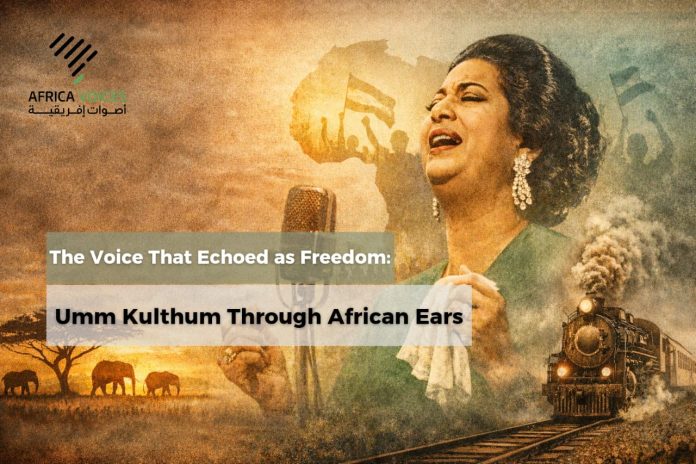

I was not setting out in search of Umm Kulthum; I was merely heading to catch a train. In Tanzania—a country of vast distances—the route from Dar es Salaam to Morogoro extends westwards like an open horizon. The train is more than transport; it becomes a fleeting world of its own, a confined stretch of time where voices, languages and faces converge.
Passengers step on and off, hauling luggage and laughter, conversing in Swahili, English and a range of local dialects. Each traveller carries a private story, though all move along the same track, regardless of where they may ultimately arrive.
As I readied myself to board, a voice—instantly recognisable, unmistakable—cut through the noise: Umm Kulthum.
I froze, as though hearing my name called out in an unfamiliar crowd. My first assumption was simple: there must be an Egyptian nearby, perhaps at least an Arab. The sound drifted from deep within the carriage. I boarded and scanned the seats, searching for familiar features, but found only ordinary African faces and composed eyes fixed on the long journey ahead.
Drawn towards the source, I approached to confirm what I was hearing. The sight surprised me: a Tanzanian man seated alone, head slightly bowed, Umm Kulthum’s voice playing from his mobile phone. No Arab passengers surrounded him. I addressed him in English. He responded in a blend of Swahili and English, yet his message was unmistakable: yes, they know her. This was Umm Kulthum—and she has many admirers here.
He did not declare, “I love Arabic music” or “I love Egypt.” He simply spoke her name, as one might refer to a cherished member of the family. I took a seat beside him. He did not understand the lyrics, and I felt no urge to interpret them. The voice, on its own, was sufficient.
In that instant, I was reminded of remarks I had heard from Africans over the years—observations not shaped by critics or scholars, but expressed instinctively. A Kenyan friend once told me that her voice made him feel as though something immense stood before him, even without comprehension. A man from West Africa said her singing conveyed the sense that someone was speaking about patience. A young Sudanese listener discerned in her performance a Sufi gravity, likening it to the recitation of sheikhs. A French youth, with memorable intensity, remarked that her voice was neither joyful nor sorrowful, but grounding.
I also recalled what Tayeb Salih once said of Cairo: that it is a city where feeling is cultivated before intellect. Within that atmosphere, Umm Kulthum functioned as an unspoken catalyst of emotion—without proclamation, without addressing anyone by name. These testimonies contain no musical analysis, yet they are saturated with sentiment. In essence, she embodied feeling itself: an extended breath, a measured cadence; a self-assured voice that did not pursue applause, but seemed to hold time in suspension.
For Fela Kuti, authentic singing meant command over time—turning song into a space of resistance. In that sense, Umm Kulthum achieved precisely this. As I watched the road unfold, questions surfaced: why this voice, why Umm Kulthum, and why here? The answer lies not in passing reflection, but in history. During the 1950s and 1960s, Egypt represented more than a nation; it signified an idea—a resonant challenge to colonial rule. Cairo stood at the centre of African liberation movements, its influence echoing across the continent. Umm Kulthum formed part of that resonance. She did not deliver overt political messages, yet her voice itself was a posture—steadfast and composed. And perhaps that was what Africa required: not a rallying speech, but a sustaining feeling.
Even in her love repertoire, her stage presence did not suggest fragility; it projected endurance and resolve. For this reason, African audiences did not regard her as foreign. Within many African cultural contexts, slowness is not equated with weakness, nor is deliberation dismissed as needless extension; both are understood instead as forms of respect for narrative. Umm Kulthum, above all, honoured the story. One of the most compelling expressions of this affinity appeared in her engagement with the Sudanese poet Al-Hadi Adam, a writer grounded in the Arabic language and animated by an unmistakably African spirit. When she performed his poem “Aghadan Alqak” (Will I Meet You Tomorrow?), the moment exceeded the bounds of artistic cooperation. It signalled recognition that her voice contained, within its cadence, something profoundly African. Al-Hadi Adam stated on numerous occasions that Umm Kulthum did not merely sing the poem; she inhabited it. What emerged was not a dynamic of passive reception, but of mutual exchange: Africa offered the narrative, and Egypt transformed it into song.
As I disembarked, I found myself recalling the villages we had passed—communities visibly worn and marked by poverty, yet still intact in identity and voice. In such places, Umm Kulthum is neither an indulgence nor an exercise in distant nostalgia. Her singing functions instead as a form of recompense for what has been lost. She did not sing about Africa explicitly; rather, she sang of experiences Africa recognises intimately: waiting, bereavement, wounded dignity, and a patience that refuses to plead for sympathy.
Ngũgĩ wa Thiong’o described culture as a domain of resistance, and as a source of voices that enable people to remain upright even in states of exhaustion. Within transnational cultural studies, Umm Kulthum is frequently invoked as an artist who may not be African by origin, yet is African in emotional register. Her voice was neither sanitised nor fashioned for superficial consumption; it carried instead the imprint of endurance, shaped by fatigue rather than spectacle.
In cafés and private homes, over crackling radios, her voice imposes a near-sacred hush. A cup lingers midway to the lips; someone closes their eyes; another waits for the refrain to return, deeper and more resonant. A Ghanaian journalist once observed: he did not grasp the words, yet he recognised the atmosphere of the post-independence moment—measured elation, coupled with a dignity wary of fracture.
Umm Kulthum required no translation. A single tonal inflection could carry her meaning. Even now, in distant African cities, when her voice drifts from an ageing radio and a listener leans in attentively, it becomes clear that she did not merely traverse the desert; the desert itself seemed embedded in her timbre.
As the train pressed on and the sound receded, I found myself certain of one thing: this was not a voice arriving from afar, but one returning after circling the globe. It affirmed that Umm Kulthum did not sing for Egypt alone, but for anyone still in search of their own voice.
Ya Sett (The epithet bestowed by admirers upon her) — incomparable before you, incomparable after you.


