

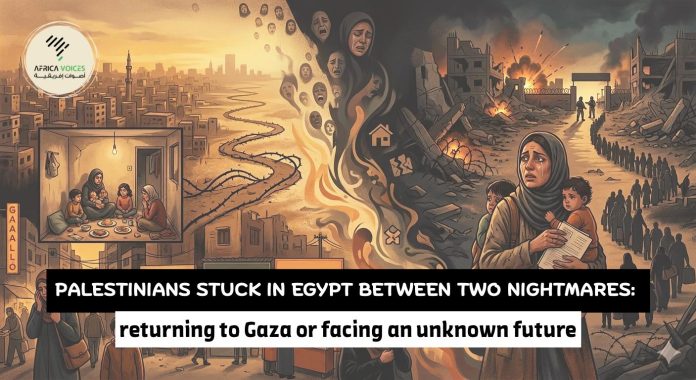

Since 2 February, when the reopening of the Rafah border crossing was announced, displaced Palestinians from Gaza in Egypt have faced an acute existential dilemma. Beyond the crossing—which reconnects them with their families and with what remains of their lives—lie painful questions and conflicting choices. They must decide whether to return to the ruins of their homes and memories as the destruction continues, or remain in Egypt and confront the uncertainty of exile and the harsh realities of a “temporary alternative homeland”.
Following the official announcement at the beginning of February that the Rafah crossing would reopen, Abeer Ibrahim, 36, began packing her belongings with firm resolve. Her aim was clear: to return to the Gaza Strip as soon as possible. She had arrived in Egypt in March 2025 with her five children, one of whom required treatment at an Egyptian hospital. The mother says she now finds herself “stuck”, without income and without any social support network. Speaking to Africa Voices, she said, “I want to return to Gaza. I have already filled out the Palestinian embassy’s application form for return”.
Abeer had travelled to Cairo in March 2025 seeking treatment for her son, who suffers from cystic fibrosis. She brought her four daughters and the ill child with her, while her husband and eldest son remained in the Gaza Strip. At the time, she had hoped that her son would receive prompt treatment and that they would soon return home, as Gaza was then experiencing a period of relative calm following the implementation of the first agreement between Hamas and the Israeli occupation.
Yet those hopes have largely faded. Securing treatment for her son has proved difficult due to the shortage of specialised medicines and the continuing conflict, which has forced the family to move repeatedly. Speaking with sadness, she said: “None of our goals have been achieved. I feel as though I came here for nothing. I have no means of survival here. Why should I continue living away from my homeland when my husband and eldest son remain in Gaza?”.
Abeer, along with her daughters and son, lives in a modest apartment provided by the Ministry of Social Solidarity during the period of her son’s treatment. Despite this arrangement, she remains gripped by an unspoken fear. Unfamiliar with life in large cities, the Gazan mother worries about her daughters moving about alone in an unfamiliar environment. Her anxiety is compounded by her diagnosis with multiple sclerosis and the possibility that she might die, leaving her children without support. “I have absolutely no income. A family gives us $100 every two months, which is not enough to live on. I worry about my daughter who goes out to school every day. My greatest fear is that I will die here and leave my children alone in this city,” she says.
Like Abeer, thousands of families—particularly women and their children who travelled for medical treatment—are seeking to return to Gaza. Records from the Palestinian embassy in Cairo reflect this demand: more than 30,000 people have registered to obtain permission to return to the Strip, representing around 30 per cent of the Palestinians who have arrived in Egypt since the war began. Despite these figures, the number of those who have actually returned has not exceeded two hundred since the crossing reopened, while movement has slowed markedly—or halted altogether—since the outbreak of the Iranian war at the end of last February.
However, reports that Israeli occupation forces systematically arrest Palestinians crossing back into Gaza have triggered deep anxiety among those hoping to return, particularly individuals who have criticised Israel on social media or expressed political views. This sense of fear was evident among the families contacted: many worry that speaking to the media could jeopardise their chances of returning or expose them to reprisals upon arrival.
Expressing the anxiety felt by thousands of Palestinians, Abeer says: “I carry a hundred fears in my heart. I’m afraid that if I stay, I will die here, and I’m afraid that if I return, we will be tortured at the crossing. Between these two extremes lies an unknown fate. I swear to God, I don’t know what to do”.
Israa Jalal shares similar concerns. The Palestinian woman, who arrived in Egypt in mid-February, says: “After what we heard from those who returned, we are now weighing every step. We are afraid of being tortured and abused”.
Israa travelled to Egypt with two sons and a daughter, leaving behind her ten-year-old son in Gaza after Israeli authorities refused to allow him to leave with her. The renewed fighting last May has since left her living in constant fear. “I fall asleep and wake up to nightmares. I sit in front of the television 24 hours a day to find out where the bombardments are taking place and what my son is doing. I have become like a scarecrow, fixed and terrified. I frighten no one else, but I am the one who is afraid”.
Ayman al-Raqab, a professor of political science at Al-Quds University who resides in Cairo, told Africa Voices that a policy of intimidation is being employed. “The occupation is attempting to prevent refugees from returning through intimidating interrogations,” he said, noting that returnees are questioned about their reasons for coming back, particularly those known for political views or activity on social media.
For others, however, the desire to return collides with an overwhelming material reality. Abu Misbah, from the Maghazi refugee camp in central Gaza, says that returning to his devastated homeland would be tantamount to returning to nothing. “I live here with eight members of my family, including six teenagers. My house was completely destroyed. It does not make sense for me to give up my apartment now in order to live in a tent with my children, waiting for a meal distributed by a charity,” he says.
He adds: “I strongly want to return, but I will not go back under these circumstances. We cannot endure a winter in a tent, deprived of any means of survival”.
Unlike those waiting for the opportunity to return, some members of the Gazan community have opted to establish businesses. In the districts of Nasr City and 6th of October City in Greater Cairo, a nascent Palestinian economic presence is taking shape. Dozens of restaurants and small artisan shops, set up by people who fled the fighting, have begun to flourish, recording notable commercial success with the support of sympathetic customers and the availability of quality products.
Even so, Palestinians in Egypt remain caught in a difficult grey zone. Many cannot realistically remain in Egypt because of worsening financial conditions and the absence of adequate social support, yet they also fear returning to a Gaza Strip that has been devastated and remains under occupation. For Abeer, Israa, and Abu Misbah, their suitcases remain packed as they wait for the next, uncertain chapter of their lives.


